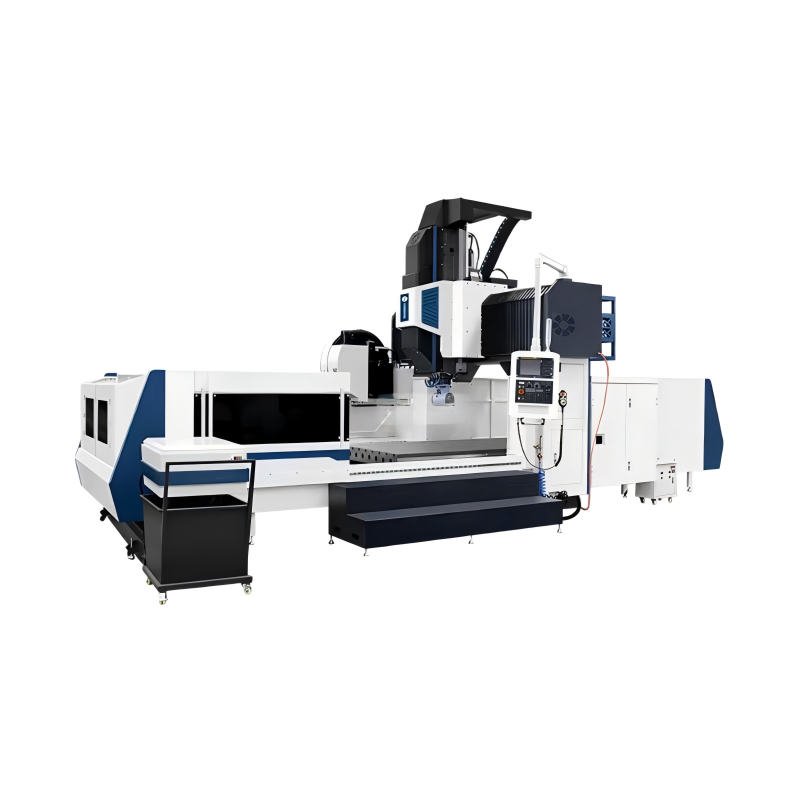
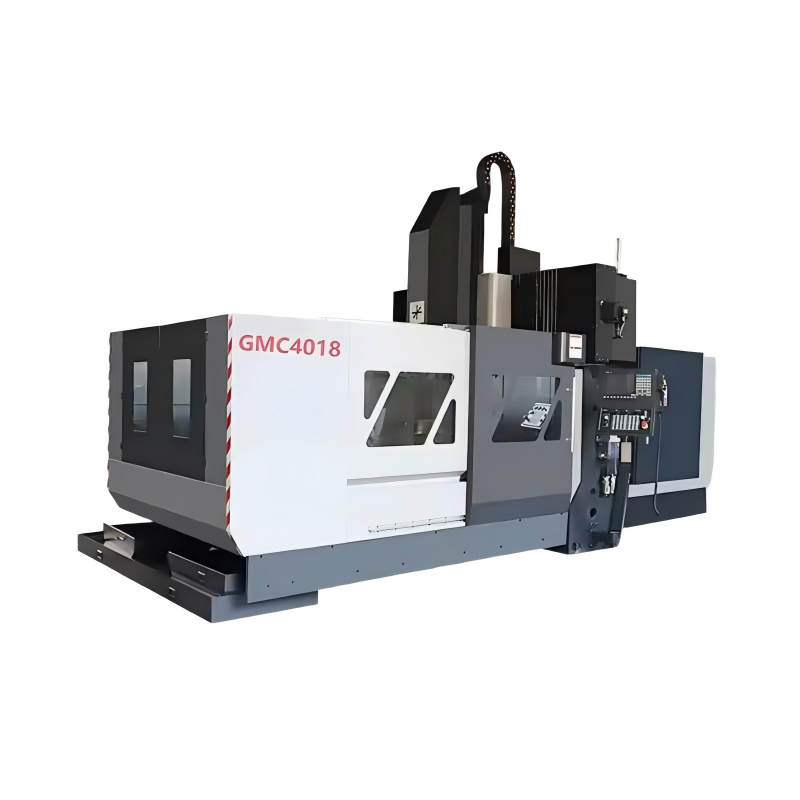
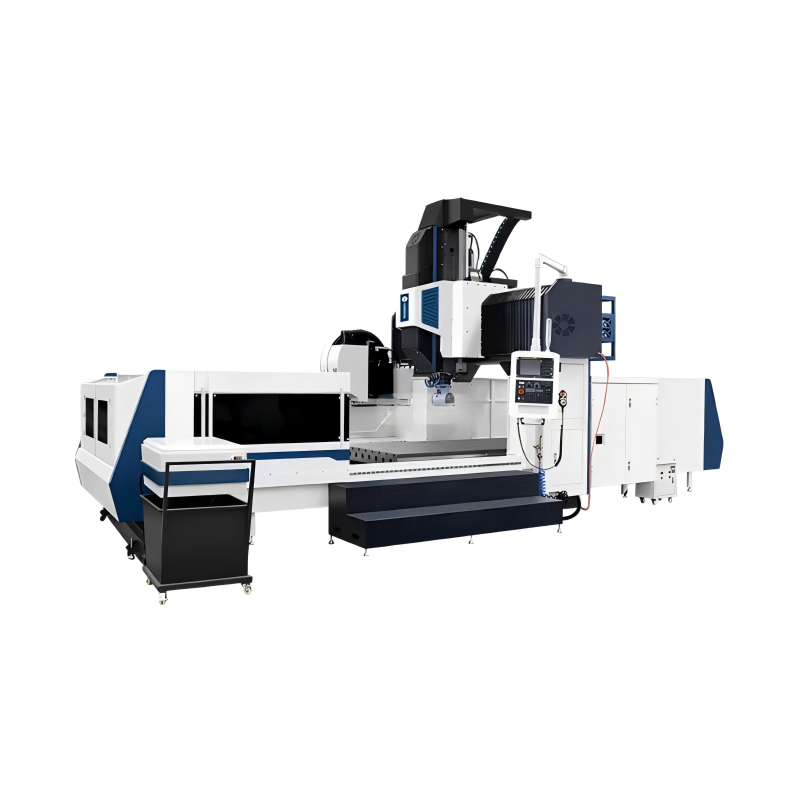
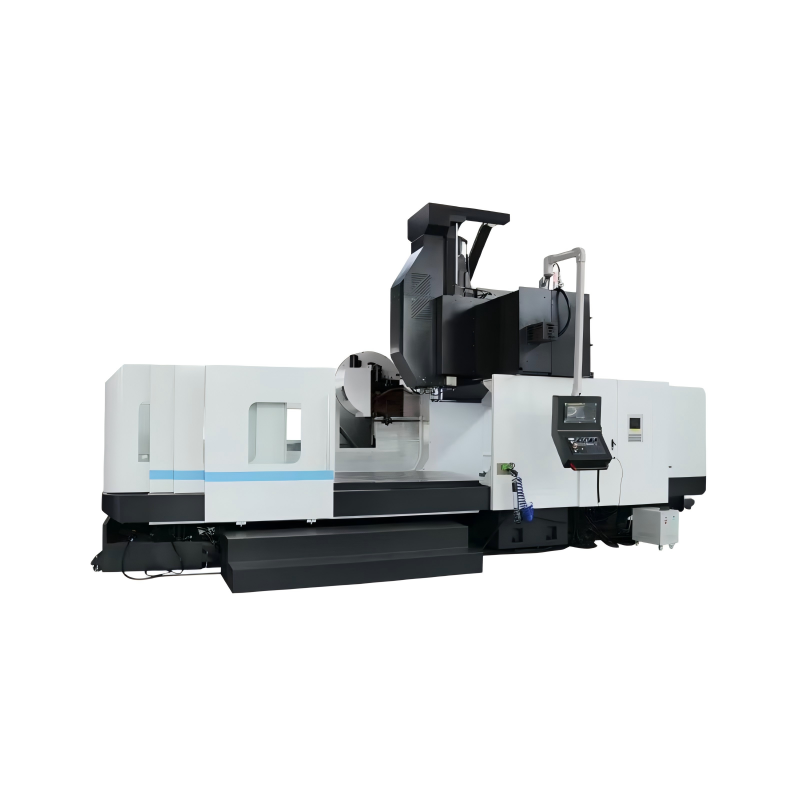
Modern manufacturing demands unprecedented precision, rigidity, and scalability—especially for large-part machining in aerospace, energy, and heavy machinery sectors. The Gantry CNC Machining Center has emerged as the structural cornerstone for such applications.
Unlike traditional bridge or column-type configurations, the gantry architecture distributes static and dynamic loads across two parallel side columns and a rigid crossbeam. This symmetrical layout inherently minimizes torsional deflection during high-force milling operations.
Rigidity is quantified not just by static stiffness but by modal response under real-time cutting conditions. Finite element analysis (FEA) of contemporary gantry frames shows first bending mode frequencies exceeding 185 Hz—critical for suppressing chatter at feed rates above 12 m/min.
Thermal stability is another decisive advantage. Dual-column thermal symmetry ensures balanced expansion, reducing positional drift to under ±1.2 µm over an 8-hour shift—verified through laser interferometry on production SMCC installations.
The crossbeam’s hollow-box construction, often reinforced with internal ribbing and cast-iron damping inserts, delivers superior vibration attenuation. Accelerometer data from operational Gantry CNC Machining Center units confirms 40% lower acceleration RMS values at 3–5 kHz compared to comparable fixed-table systems.
Dynamic performance hinges on axis synchronization fidelity. Modern systems employ dual linear motors on the X-axis—one per column—with master-slave position control and nanosecond-level encoder interpolation. This eliminates mechanical coupling errors inherent in rack-and-pinion or belt-driven alternatives.
Y-axis travel is no longer constrained by column height alone. Advanced kinematic compensation algorithms dynamically adjust servo gains based on carriage position, maintaining ±0.8 µm contouring accuracy across full 6-meter Y-travel ranges.
Z-axis design has evolved beyond simple quill mechanisms. High-performance variants integrate hydrostatic counterbalance and direct-drive spindles, enabling rapid tool-change cycles (<2.1 s) while sustaining spindle runout below 1.5 µm at 15,000 rpm.
Integration with Industry 4.0 infrastructure is non-negotiable. SMCC platforms embed OPC UA servers natively, supporting real-time acquisition of 127+ machine parameters—including axis jerk profiles, coolant pressure harmonics, and thermal gradient maps—without external gateways.
Tool monitoring is no longer reactive. Acoustic emission sensors embedded in the crossbeam detect micro-chipping events 0.8 seconds before surface finish degradation becomes measurable—enabling predictive tool replacement within ±3 machining minutes.
Material removal rate (MRR) optimization is achieved via closed-loop power modulation. When spindle load exceeds 82% for >1.7 s, the system automatically adjusts feed override and depth-of-cut in <40 ms—preserving cutter life without operator intervention.
Structural modularity enables field upgrades. A 2023 retrofit program demonstrated that adding carbon-fiber-reinforced polymer (CFRP) beam cladding increased dynamic stiffness by 29%, validated against ISO 230-2 standards.
Vibration isolation has moved beyond passive mounts. Active mass-dampers tuned to 12.4 Hz suppress floor-coupled resonance—critical when operating near HVAC or crane infrastructure. Field measurements show 73% reduction in transmitted vibration energy.
Collision avoidance now operates at the firmware level. The SMCC’s real-time kernel monitors all six degrees of freedom simultaneously, triggering emergency deceleration at jerk thresholds exceeding 1.8 g/s—well below human reaction time.
Surface integrity outcomes are directly traceable to gantry dynamics. In titanium alloy (Ti-6Al-4V) impeller machining, surface roughness (Ra) variation across a 1.2 m diameter dropped from ±0.32 µm to ±0.09 µm after upgrading from a legacy portal mill to a modern Gantry CNC Machining Center.
Energy efficiency gains are structural, not merely electrical. Regenerative braking on all three axes recovers up to 18.7% of kinetic energy during rapid directional changes—measured across 42,000 cycle logs from certified SMCC deployments.
Maintenance predictability is enhanced through digital twin correlation. Strain gauges mounted at critical beam-column junctions feed live stress data into a physics-based model, forecasting bearing wear onset with 94.3% accuracy at 300-hour intervals.
Finally, scalability is inherent—not bolted on. The same core gantry architecture supports configurations from 2.5 m × 1.8 m × 1.2 m working envelopes up to 18 m × 6 m × 2.5 m, with consistent geometric accuracy maintained per ASME B5.54 Annex D protocols.
This convergence of structural intelligence, dynamic responsiveness, and embedded diagnostics defines the next generation—not just of machine tools, but of manufacturing capability itself.
 April 29, 2026
The fabrication of wind turbine tower structures presents a unique confluence of scale, geometric complexity, and metrological rigor. As turbine heights exceed 160 meters and tower diameters approach 5.5 meters, traditional machining approaches—such as mu
Read MoreApril 29, 20261. Structural Rigidity and Dynamic Stability in Gantry ArchitectureThe foundational advantage of the Gantry CNC Machining Center lies not in its size alone, but in the inherent structural integrity conferred by its bridge-type architecture. Unlike floor-m
Read MoreMay 18, 2026Modern aerospace manufacturing demands extreme precision, structural integrity, and scalability—especially for wing spars, fuselage panels, and engine nacelles. These components often exceed 10 meters in length and require micron-level tolerance across va
Read MoreMay 19, 2026Modern heavy-duty industrial manufacturing demands unprecedented levels of dimensional stability, dynamic rigidity, and scalable work envelope performance. Conventional bridge-type or fixed-table CNC machining centers increasingly reach operational limits
Read MoreMay 21, 2026Automotive Original Equipment Manufacturers (OEMs) face unprecedented pressure to reduce cycle times, improve dimensional consistency, and accommodate rapid model proliferation—all while maintaining sub-50 µm geometric tolerances across large structural c
Read MoreMay 22, 2026Thermal stability is a decisive factor in high-precision manufacturing environments. In large-scale Gantry CNC Machining Center applications—particularly those involving aerospace components, heavy-duty dies, and precision molds—dimensional drift due to t
Read MoreMay 23, 2026The Gantry CNC Machining Center represents a cornerstone architecture in large-scale precision manufacturing. Its rigid, bridge-like structure enables high-stiffness motion across expansive work envelopes—commonly exceeding 3,000 mm in X and Y axes. Unlik
Read MoreMay 24, 2026Modern large-scale manufacturing demands precision, repeatability, and adaptability—especially for aerospace, energy, and heavy machinery sectors. The Gantry CNC Machining Center has emerged as a critical platform for high-volume, high-accuracy part produ
Read MoreMay 25, 2026Modern high-performance Gantry CNC Machining Center systems operate at the frontier of precision manufacturing. Their structural rigidity, large work envelope, and multi-axis synchronization enable machining of aerospace monoliths, energy turbine housings
Read MoreMay 26, 2026The Gantry CNC Machining Center represents a paradigm shift in large-scale precision manufacturing. Unlike conventional bridge-type or fixed-table configurations, its structural rigidity, symmetrical load distribution, and dual-driven axis architecture en
Read MoreOur professional sales team is always ready to assist you.